Nursery
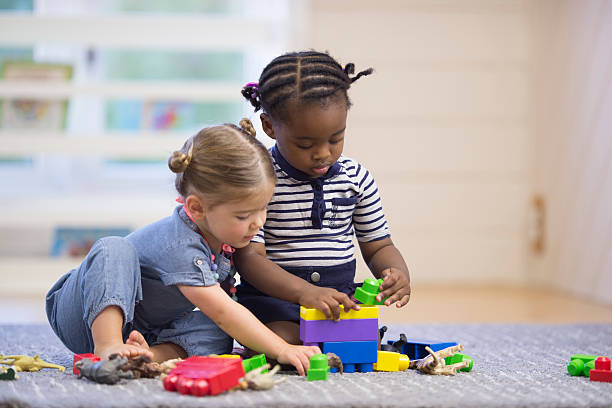
Our school offers an engaging, nurturing environment for every child, during the most critical early years, starting in infancy (3 months).
At PMIS, our infant program (Nursery 1) is much more than just a daycare. Infants learn about the world around them by experimenting and trying new ways of doing things, just like scientists. The bonds they form with warm, nurturing teachers and the stimulating environment of this classroom form the strong foundation for STEAM learning. Learning experiences in the Nursery 2 classroom address the evolving developmental needs of this increasingly mobile age group, while milestone development continues to be guided by five developmental areas.
Our curriculum is designed to ensure that even our youngest learners are developing and meeting significant milestones in these five areas:
- Cognitive Development: Infants develop the ability to pay attention and to engage and interact with others. At Nursery 2 (Twos) children develop the ability to think critically and creatively and to understand their world.
- Language and CommunicationDevelopment: Infants develop the ability to communicate verbally. At Nursery 2 (Twos) children develop the ability to communicate effectively using oral and written language; to understand and respond to communication of others.
- Physical Development and Health: Infants develop the ability to intentionally move parts of their body. At Nursery 2 (Twos) children develop the ability to coordinate and control large and small muscle movements. Children develop increasing awareness of health and safety concepts.
- Social-Emotional Development: Infants practice different ways to get their needs met. At Nursery 2 (Twos) children develop the understanding of their relationships with others such as family, friends, and community members; and increase awareness of themselves and their emotions.
- Approaches to Learning: Infants explore the world around them. At Nursery 2 (Twos) children develop their problem-solving abilities, and become more independent.
 Preschool
In Pre-Kindergarten (36 months - 4 years), learning experiences are personalized and guided by our early education curriculum. To ensure school readiness, and to prepare each child for the future, our Pre-Kindergarten program continues to develop the STEAM learning approach which offers engaging activities for our learners within small and large groups. The classroom features hands-on materials for measurements and calculations, robotics materials and introduction to coding concepts, opportunities for reading, writing, dramatic play, and music. We guide children through these significant developmental areas:
- Approaches to Learning: Children develop independence, as well as creativity and cooperation. Children develop the ability to find solutions to simple problems.
- Logic and Reasoning: Children work on patterning, object sorting, and word problems. Children develop the ability to sort and solve simple puzzles.
- Literacy: Children are exposed to language through stories, small-group reading, and journal writing. Children develop the ability to ask adults to read printed information, draw figures and shapes to convey meaning, and use picture and verbal cues.
- Language: Children are encouraged to use language to think and communicate. Children develop the ability to respond appropriately to questions about books, and repeat different words/sentences to get another person to respond.
- Math: Children are exposed to measurement, graphing and numeral identification. Children develop the ability to identify numerals and alternating patterns.
- Physical Development and Health: Children practice fine motor skills, such as cutting with scissors and holding a pencil or crayon, as well as deepen their understanding of health and nutrition. Children develop the ability to follow directions, complete tasks with little supervision, and participate actively in group games.
- Social-Emotional Development: Children learn cooperation, conflict resolution, and other critical life skills. Children develop the ability to use emotional words (such as “I’m mad”) to get needs met, follow established rules and routines in the classroom, and play well with others.
- Creative Arts Expression: Children express ideas and feelings through music, movement, visual arts, and dance. Children develop the ability to use materials, such as pencils, paints, play dough, and musical instruments, in different and varied ways.
- Social Studies: Children develop a respect for diversity, family, and community. Children develop the ability to use terms related to location, direction, and distance, as well as to use the language of time (day, night, yesterday, today, tomorrow).
- Nature and Science: Children will learn how to make predictions, observe, and generalize data through experimentation and investigation. Children develop the ability to classify objects into living and non-living categories, provide explanations for why an event/outcome occurred, and demonstrate some persistence and creativity in solving a problem.
Kindergarten
In our Kindergarten classroom an inviting, stimulating, and inclusive setting awaits your child. Children gain a strong foundation to be prepared for primary school. Academic and learning experiences explore Literacy & Language, Math, Social Studies, Science, and Self-Help & Social Skills. Their progress is monitored and recorded across these five key knowledge areas.
Literacy & Language: Children will focus on phonemic awareness, comprehension, and letter recognition, in large and small group instruction, as well as independent learning centers. Skill development is focused on understanding story concepts; understanding how print works; understanding how words are built; writing development; expressing ideas clearly; and vocabulary.
- Math: Real-life situations illustrate math concepts, as children develop their problem-solving and critical thinking skills. Math is approached through five different modes of learning: Whole Group Instruction, Collaborative Learning, Small Group Instruction, Adaptive Learning, and Independent Practice.
- Social Studies: Sharing personal experiences, family stories, and traditions, enables students to develop important skills such as understanding time and place, respecting others, and gaining a deeper understanding of the world around them.
- Science: The scientific method is explored to help children gain skills in areas such as observing local weather conditions; describing patterns over time; and discovering animals, plants, and the environment.
- Self-Help & Social Skills: Self-Help and Social Skills play an essential role in kindergarten. These skills include holding a pencil with a proper grip; using scissors to cut preformed shapes; following directions; working independently; asking for help as needed; recognizing and following classroom routines and procedures; independently attending to personal care; understanding another’s point of view; showing conflict resolution skills; and respecting the rights of others.